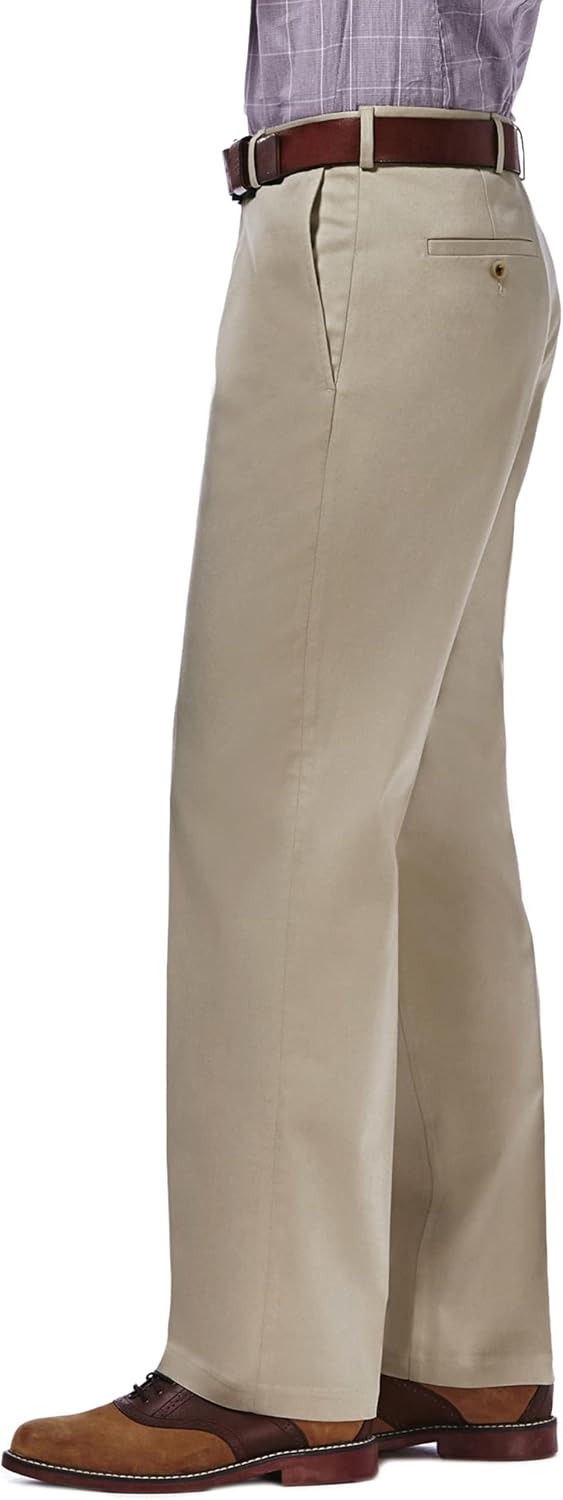
Haggar has been making dress pants in America — well, selling them widely in American department stores — since 1926, which makes it one of the oldest workwear brands still actively on shelves. If you’ve ever stood in a JCPenney or scrolled past a sponsored result on a department store site wondering whether the $30 pair and the $55 pair are actually different garments or just the same factory run with different hang tags, this article is for you. The short answer: they are genuinely different. The longer answer involves fabric composition, waistband construction, and some honest math about cost-per-wear that determines which tier actually earns its price. We’re going to walk through all three price bands — the entry $30 range, the mid-tier $45 range, and the premium-for-Haggar $55 range — and give you a clear decision rule by the end.
One note on sourcing: this analysis draws on Haggar’s published product specifications, aggregated owner reviews across major retail platforms, and editorial coverage from GQ, Who What Wear, Wirecutter, and Esquire, all of whom have addressed Haggar in the context of affordable workwear roundups. Neither this publication nor its writers have personally owned or worn these garments — every judgment here is grounded in what the specs and the review record show.
What Haggar Actually Sells: The Three Tiers Mapped
Before comparing, it helps to understand how Haggar structures its lineup. The brand doesn’t market these as “good, better, best” tiers — they’re organized by product line name, which can be confusing when you’re shopping. Here’s how the pricing maps to the actual lines as of May 2026:
By the numbers:
- ~$28–$35: Classic Fit dress pants and basic stretch chinos (entry tier)
- ~$40–$50: LifeStyle Performance, Cool 18 Pro, and stretch comfort trousers (mid tier)
- ~$52–$65: Premium No Iron, Flex-Right waistband trousers, and suit separates (upper tier)
These ranges shift slightly by retailer and sale cycle — Haggar runs frequent promotions — but the construction differences between tiers remain consistent regardless of the current selling price.
The $30 Tier: What You’re Actually Getting
The entry-level Haggar pant is a straightforward dress trouser built primarily from polyester-dominant blends, often in the 65% polyester / 35% viscose or similar synthetic range. Haggar’s published specs confirm the polyester-heavy composition, and this isn’t a criticism — it’s a deliberate engineering choice for wrinkle resistance and price point.
What owners consistently report at this tier: the pants press well, hold a crease reasonably for one or two wears, and survive machine washing without distorting. What they also note: the fabric has a visible sheen under office lighting that reads as budget-tier to anyone who knows dress trousers. The waistband is standard sewn construction — no stretch, no give — and the silhouette tends toward a fuller, less tailored cut even in the “classic slim” versions.
The honest use case for the $30 tier is high-turnover situations: a retail management role where you’re on your feet eight hours and pants wear out fast, a first job where you need four pairs on a constrained budget, or a job function where you’ll never be standing next to someone wearing a $300 trouser and the comparison won’t be made. GQ’s coverage of affordable dress pants has consistently noted that polyester-blend work trousers at this price point serve a real functional need — they’re not aspirational purchases, and they shouldn’t be marketed as such.
The fit reality: Haggar’s fit labels (“classic,” “slim,” “straight”) are generous cuts relative to what those same words mean at COS or Suitsupply. If you’re cross-shopping, account for at least one size of looseness relative to a European-fitted equivalent.
The $45 Tier: Where Haggar Actually Gets Interesting
The mid-tier — primarily the Cool 18 Pro and LifeStyle Performance lines — is where Haggar’s engineering investment shows up in ways that matter for professional wear. These pants typically use higher-percentage stretch fiber blends (often incorporating spandex at 2–4%) alongside polyester and a higher proportion of rayon or viscose, which produces a fabric that drapes more softly and reads as less synthetic under office lighting.
The Cool 18 Pro, specifically, has accumulated a meaningful review record. Across aggregated owner reviews on major retail platforms, the pattern is consistent: buyers note that the fabric feels noticeably different from the entry tier — less crisp-plastic, more matte — and that the stretch waistband construction (Haggar calls this their “Flex-Right” feature on some versions, a hidden expandable waistband panel) meaningfully changes comfort for anyone sitting at a desk for long stretches.
Wirecutter’s dress pants coverage has highlighted stretch waistband technology as one of the most genuinely useful innovations in affordable workwear over the past decade, and Haggar’s implementation at this tier is functional rather than gimmicky. The expansion range is modest — we’re talking 2–3 inches of give, not a full size — but owners report it makes a real difference over an eight-hour workday.
The $45 tier also shows up better in photographs and video calls, which matters in hybrid work environments. The matte drape of the higher viscose content reads as more intentional on screen. Esquire’s workwear coverage has noted that fabric surface — specifically, whether a trouser has a flat or shiny finish — is one of the first things that signals price point on camera, even when the cut is otherwise similar.
The construction upgrade: At this tier, Haggar typically includes a more substantial waistband lining, belt loops with reinforced stitching, and in some lines, a quarter-lined leg that improves the way the trouser falls over shoes. These aren’t dramatic improvements, but across regular wear they contribute to the pants holding their shape longer.
The $55 Tier: Premium for Haggar, Not Premium in the Market
Let’s be clear about framing before going further: “premium Haggar” is not the same claim as “premium trousers.” A $55 Haggar pant sits in a different universe from a $150 Banana Republic dress trouser or a $300 Suitsupply wool flannel. The comparison being made here is internal — what does spending $55 versus $30 within the Haggar ecosystem actually buy?
At this tier, Haggar’s suit separates and Premium No Iron trousers introduce wool-blend fabrics — often a 50% wool / 50% polyester composition — and more traditional tailoring details: quarter-top pockets, a proper lining through the seat and thighs, and in some lines, a plain or cuffed hem option. The wool content changes the drape significantly. Wool, even at 50%, has a natural weight and movement that reads as more formal and more expensive than any synthetic blend.
Who What Wear’s coverage of work trousers has noted that wool content is the single most reliable indicator of whether a trouser “reads expensive” to others, even when the actual price is moderate. At $55, Haggar’s wool-blend options are competing credibly with similar compositions from older department store house brands, though not yet with purpose-built brands like Suitsupply or J.Crew’s Ludlow line.
What you’re not getting at $55: Full canvas construction (not relevant at this price point), a high wool percentage (you’re at 50% at best), or a fit that competes with slim-tailored European workwear. The silhouette remains relatively traditional and roomy. Tailoring alterations — at the $20–$40 most tailors charge for a basic hem and seat adjustment — can improve the fit considerably and are worth factoring into the total cost math.
Total cost calculation:
- Entry tier at $30 + $0 alterations = $30 total, 18-month lifespan based on owner reports
- Mid-tier at $45 + $30 alterations = $75 total, 24–30 month lifespan
- Upper tier at $55 + $30 alterations = $85 total, 30–36 month lifespan
On a per-month basis, the mid-tier and upper tier converge to nearly the same cost once you account for wear cycle. The real question is what environment you’re dressing for.
The Decision Rule: If X, Then Y
Here’s the plain-language framework for choosing your tier:
If you need volume on a tight budget — multiple pairs for a physically demanding job, or you’re building a first work wardrobe from scratch — buy the $30 tier and don’t feel bad about it. The pants work. They won’t impress anyone, but they’ll do the job.
If you’re in a hybrid office or appear on video regularly — any client-facing role, any environment where you’re standing next to people who spend more on clothes — the $45 Cool 18 Pro or LifeStyle Performance line is your actual entry point. The matte drape and stretch waistband justify the upgrade. Add basic tailoring if the fit runs wide for you.
If you need something that reads as a proper suit trouser for occasional client meetings or interviews — and you’re not yet ready to invest in Suitsupply or Banana Republic’s better lines — the $55 wool-blend suit separates make sense as a temporary solution. They won’t carry you indefinitely, but they’ll perform in the situations that matter most until you’re ready to invest at a higher tier.
One overarching note: Haggar lives at the functional end of the workwear spectrum. Readers of this site who regularly invest in Reiss, COS, or Theory will find that Haggar sits below their usual consideration set — and that’s fine. But for the professional who needs dependable, presentable trousers while keeping budget available for more visible wardrobe investments (a better blazer, quality footwear), Haggar’s mid-tier represents genuinely honest value. The brand knows what it is, and at $45, it delivers on that promise.