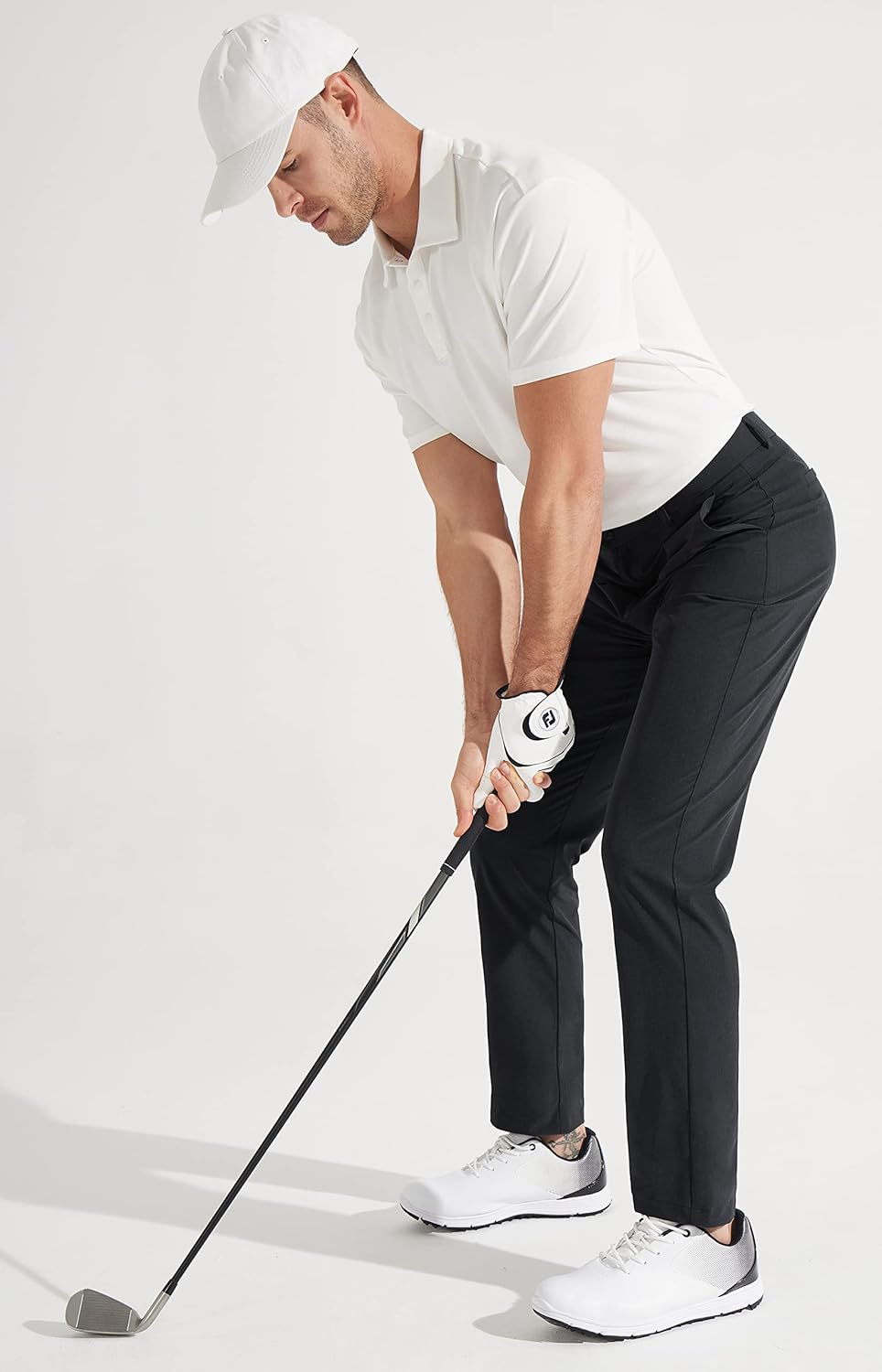
If you’ve ever worn a pair of golf pants on the weekend and thought, these are more comfortable than anything in my work wardrobe — you’re not imagining it, and you’re not alone. Golf pants (also called performance trousers or stretch chinos, depending on the brand) are cut from fabrics that contain a small percentage of synthetic fiber — typically spandex or elastane — which lets the fabric move with your body rather than against it. The result is a trouser that looks tailored but feels closer to athletic wear. The question this article answers is a practical one: which of these pants can genuinely pass at the office, which ones read as sporty no matter what you do, and how do you tell the difference before you buy?
If you’re already familiar with stretch fabrics and you’re wondering whether to invest in a $180 pair or a $350 pair for work, that’s exactly the decision frame we’re working through here. We’ll map the crossover categories, name the signals that separate “office-ready” from “course-only,” and give you clear if-then guidance at three price tiers.
Why the Golf Pant Crossover Has Actually Landed
This isn’t a new conversation, but it has accelerated meaningfully. Business of Fashion’s analysis of athleisure’s infiltration of professional dress has tracked how pandemic-era hybrid work normalized performance fabrics in previously formal contexts. The shift isn’t a trend gimmick — it reflects a structural change in what “professional” looks like across creative, consulting, and technology sectors.
The key development is that major workwear brands have converged on a near-identical construction to what golf brands were already making. A stretch chino from Banana Republic’s Rapid Movement line, a technical trouser from Ministry of Supply, or a performance pant from Bonobos uses the same core technology — a woven fabric with two to four percent elastane — that Footjoy, Adidas Golf, and Callaway put in their course trousers. The fabrics are close enough that a shopper comparing them side by side would struggle to identify which was made “for golf” and which “for work.”
What that convergence means for you: the category distinction (golf vs. office) matters less than the specific design signals on each individual pair. You’re evaluating cut, color, finish, and detail — not marketing category.
The Four Signals That Separate Office-Ready From Course-Only
This is the practical core of the crossover question. Reviewers across GQ and Esquire’s coverage of men’s smart-casual trousers consistently point to the same set of visual cues that determine whether a stretch pant reads as professional or athletic. Here’s how to apply them as a buying filter.
1. Waistband Construction
A belt-loop waistband with a concealed or flat-front closure reads as tailored. A full elastic waistband — even a sophisticated one — reads as athletic or casual, regardless of how well-cut the leg is. Partial elastic at the back only (a construction common in stretch chinos from J.Crew and Club Monaco) is the middle ground: it offers give without flagging as athletic wear. For office environments, front flat-front with belt loops is the safest read.
2. Fabric Surface and Sheen
Golf fabrics engineered for outdoor UV resistance and moisture wicking often have a subtle technical sheen — a slightly synthetic surface quality — that is immediately legible as performance wear under office lighting. Matte-finish stretch fabrics (usually woven poly-wool blends or cotton-elastane) photograph and read as conventional trousers. If a fabric looks slightly “too smooth” or has a dry, mechanical hand-feel, it’s likely optimized for the course, not the conference room. Owners of Ministry of Supply’s Kinetic Twill trousers consistently note the matte finish as a key factor in their office credibility.
3. Leg Shape and Taper
Golf pants historically ran slightly wider in the thigh to allow a full swing address position. While many modern golf pants have updated to slimmer cuts, trousers with an obvious flare below the knee or a dramatic high-rise/low-rise silhouette still carry course associations. A straight or slightly tapered leg from hip to ankle — similar to what you’d find in a classic dress trouser — is the office-safe geometry.
4. Pocket and Seam Detail
Functional, exposed zipper pockets on the thigh or cargo-style placements signal athletic intent. Seam lines that arc or angle rather than running straight vertical lines echo athletic construction. For office wear, you want pockets that sit flush, open at a conventional angle, and don’t draw the eye. Back welt pockets (the flat, slit-style pockets on dress trousers) are the clearest dress-code signal available — if the golf pant has them, it’s already halfway to office-ready.
Price-Tier Breakdown: What the Budget Actually Buys
By the numbers:
| Tier | Price Range | Typical Fabric | Best For |
|---|---|---|---|
| Entry | $60–$120 | Cotton/elastane | Casual offices, weekend crossover |
| Mid | $130–$220 | Poly-wool or woven tech | Hybrid and smart-casual environments |
| Investment | $250–$400+ | Matte performance-woven | Client-facing, premium smart casual |
Entry Tier ($60–$120): Amazon Essentials, Banana Republic Factory, Uniqlo Slim Fit Chinos
At this tier, you’re getting cotton-elastane fabrication — usually 97-98% cotton with a small spandex addition. Esquire’s smart-casual trouser roundup notes that Uniqlo’s stretch slim-fit chinos consistently outperform their price point in fit consistency and color depth. The tradeoff is durability: owners report that pilling begins at the inner thigh after 12 to 18 months of regular wear, and the elastane content can degrade faster in warm machine-wash cycles.
For office use, entry-tier stretch chinos work well in casual or hybrid-first environments where denim is acceptable on some days. They’re not the right call for client meetings or formal business-casual environments. The savings are real, but the fabric reads as casual on close inspection.
If X = your office allows dark jeans on Fridays, then Y = entry-tier stretch chinos are sufficient for most of your week.
Mid Tier ($130–$220): Bonobos Stretch Weekday Chino, Club Monaco, Suitsupply Chinos
This is where the crossover genuinely works. Mid-tier stretch trousers in this range typically move to woven poly-wool or poly-cotton blends with elastane, which produce a matte, slightly structured surface that holds a crease better than pure cotton. Bonobos’ Weekday chino line has been cited in GQ’s performance trouser coverage for its belt-loop waistband and back welt pocket construction — two of the signals that read as office-appropriate.
Suitsupply’s stretch chinos benefit from the brand’s tailoring infrastructure: they run slimmer, press better, and hold their shape through a longer workday. Owners reviewing them on style forums note that they pass dress-code inspection even in environments that skew toward traditional business casual.
The honest tradeoff at mid-tier: you’re paying for the surface credibility of woven fabric and tailored construction, not necessarily for longevity over a pure cotton chino. The performance fabric advantage — wrinkle resistance, four-way stretch — is real and noticeable, but you’ll likely replace them in three to four years with regular wear.
If X = you’re in a hybrid office with client-facing days mixed in, then Y = mid-tier stretch trousers from Bonobos or Suitsupply are the right spend. You don’t need to go higher unless presentation tier matters.
Investment Tier ($250–$400+): Theory Zaine Pant, Canali Performance Wool, Vince Technical Trouser
At this tier, the “golf pant” framing largely dissolves — what you’re buying is a premium tailored trouser that happens to incorporate performance construction. Theory’s Zaine stretch wool trouser, for example, uses a milled wool-elastane blend that reads identically to conventional suiting fabric on casual inspection. The stretch is invisible; the office credibility is high.
Business of Fashion’s coverage of luxury performance suiting has noted that this segment — technical wool trousers from Theory, Canali’s Performance line, and similar — is growing specifically because senior professionals want the comfort advantage of stretch without any visible athletic signaling. Owners of Theory’s stretch trousers consistently report that the wrinkle resistance is genuinely meaningful on travel days, and that the fabric holds a crease through a full workday without pressing.
The case for spending here is specific: if your role requires consistent client presentation across long days — consulting, architecture, agency leadership — the cost-per-wear math favors durability and presence over time. The case against is equally clear: if you’re in a casual creative office five days a week, you’re paying for office credibility you don’t need.
If X = you’re regularly in client-facing environments where your dress signals professional authority, then Y = Theory or Canali performance trousers justify the price. If you’re mostly internal, mid-tier wins on value.
The Style Decisions That Complete the Crossover
A stretch trouser doesn’t make itself office-appropriate in isolation. Who What Wear’s smart-casual explainer makes the useful point that business casual reads as a system — individual pieces are evaluated in context. A few reliable rules for making the crossover work:
Pair upward. A stretch chino that reads slightly casual is pulled into business territory by a structured blazer or a well-fitted OCBD (Oxford cloth button-down, the classic slightly-casual dress shirt). The trouser doesn’t need to carry the whole outfit.
Footwear matters more than you think. The same mid-gray stretch trouser reads as sport-adjacent with white-soled sneakers and reads as smart casual with a leather Chelsea boot or Derby shoe. This is your fastest style lever.
Avoid obvious golf colorways in office settings. Olive, stone, and navy work year-round. Bright “coastal” blues, lime, or any pastel borrowed from the Pebble Beach pro shop announce golf-context loudly. Neutral colorways give you crossover range; bold golf colors narrow it.
Length and break. Golf pants are often cut with a slight cropped ankle break to clear the shoe at address. For office wear, a clean quarter-break (where the trouser just touches the top of the shoe) or a full no-break on slimmer cuts reads more formally. If your golf pant runs cropped without intentional styling, it will read as athleisure.
The Decision Rule
If your office is creative, hybrid, or explicitly smart-casual, the stretch trouser crossover is not just viable — it’s arguably a smarter choice than conventional cotton chinos. The comfort advantage is real, the visual difference is minor, and the durability of performance-woven mid-tier options is comparable to traditional workwear.
The line is this: if the trouser has belt loops, a flat front or concealed waistband, back welt pockets, a matte fabric surface, and a straight or tapered leg — it’s office-ready, regardless of whether it was marketed as a golf pant. If it has an elastic waistband, visible technical seaming, a shiny surface, or cargo pockets, no amount of blazer-pairing will cross it over.
Shop the signals, not the category label. The best work trouser for you might be sitting in the golf section — it just needs to pass four checkboxes before you take it to the conference room.