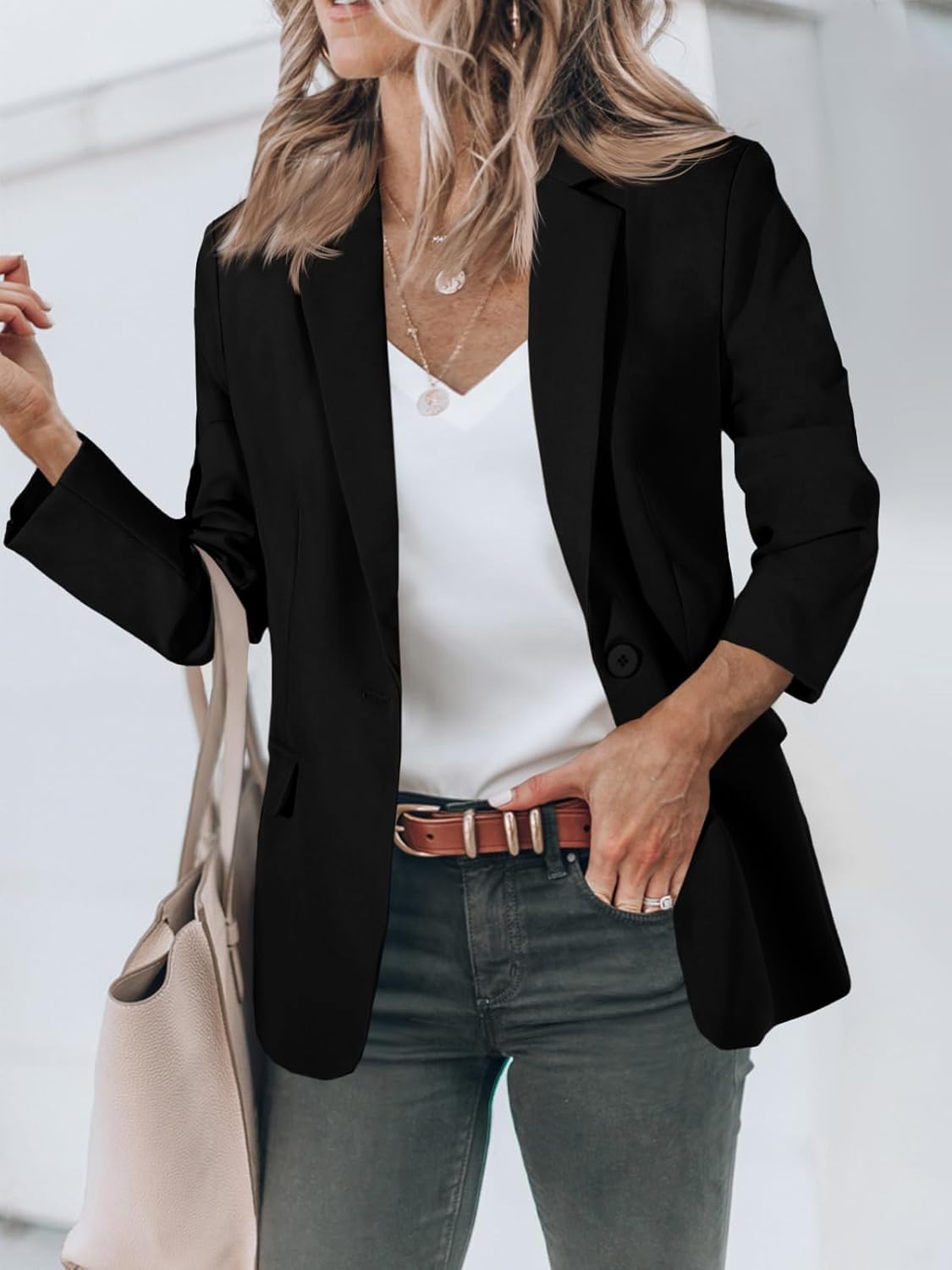
If you’ve ever ordered a blazer online and held it up thinking this looks right — then put it on and found the sleeves hanging past your knuckles — you’ve hit the single most persistent problem in women’s workwear: sleeve length calibration. A blazer (a structured, tailored jacket worn as a standalone top layer, usually with notched or peaked lapels) lives or dies by how its sleeve lands on your wrist. Too long and even an expensive jacket looks borrowed. Too short and the whole silhouette reads unfinished. The problem is especially common with Amazon’s mid-range blazer market, where sizing is optimized for broad fit ranges rather than individual proportions.
This guide is built from pattern analysis across aggregated buyer reviews of some of the most-purchased women’s blazers on Amazon. The goal is practical: before you add to cart, you’ll know which blazer styles are consistently flagged for sleeve issues, which ones solve the problem by design, how to measure your own arm before buying, and what your real options are when the fit isn’t quite right.
Why Sleeve Length Goes Wrong So Often
The core issue is how mass-market blazers are graded — “grading” being the industry term for how a pattern scales up or down between sizes. Per Refinery29’s blazer fit guide, most ready-to-wear sizing adds sleeve length uniformly as size increases, even though taller and shorter proportions don’t scale that cleanly. A size 12 blazer will have longer sleeves than a size 6, but a size 12 woman with a short torso may have the same arm length as a size 8 with a long torso. The sleeves end up fitting neither correctly.
Amazon’s marketplace compounds this because product pages aggregate reviews from buyers across multiple size runs. A blazer with 4.3 stars overall may have dozens of sleeve-length complaints buried in otherwise enthusiastic reviews — reviewers who love the fabric, the shoulder, the color, but still note that the sleeves run long. Because those complaints don’t knock the star rating below five, they’re easy to miss unless you read deeply.
The pattern across popular blazers is striking:
| Blazer | Sleeve Complaint Pattern | Design Mitigation? |
|---|---|---|
| LookbookStore Notched Lapel | Sleeves run long — noted by repeat buyers across multiple colors | None built in |
| ELLEVEN Herringbone Tweed | Short sleeves flagged by taller reviewers | None built in |
| PRETTYGARDEN Lined Blazer | Lining protrudes at sleeve hem | None built in |
| ELLEVEN Ruched 3/4 Sleeve | Ruched design praised for eliminating alteration need | Yes — ruching is the fix |
| Cicy Bell Open-Front Blazer | Proportions generally praised; shoulder construction noted as well-calibrated | Partial — better overall grading |
The data point that stands out: the LookbookStore Notched Lapel buyer who purchased the same blazer five times across multiple colors still flags the sleeve length as longer than ideal. Five repeat purchases tells you the blazer is genuinely good — but even loyal buyers adapt rather than consider the sleeve issue resolved.
Which Blazer Designs Solve the Problem by Construction
The most instructive case in this category is the ELLEVEN Ruched 3/4 Sleeve blazer. Reviewers consistently praise it not just because the ruching (gathered, textured fabric along the sleeve) looks intentional, but because it functionally sidesteps the fit problem. A 3/4 sleeve — one that ends between the elbow and wrist — removes the wrist-length fit requirement entirely. And because ruching adds texture that reads as deliberate design, the sleeve looks finished regardless of where exactly it falls on any given arm. Per The Cut’s overview of Amazon’s best-reviewed blazers, this kind of design-forward sleeve treatment is increasingly showing up in mid-market workwear precisely because it solves a manufacturing challenge without requiring the customer to tailor.
The Cicy Bell Open-Front Blazer gets mentioned in a different way — reviewers specifically praise the shoulder construction for giving shape “without looking ridiculous,” which is a signal that the overall proportional grading is more carefully considered. When a jacket’s shoulder width, chest, and sleeve balance correctly, minor sleeve length variation is less visually disruptive. That doesn’t mean the Cicy Bell is immune to sleeve complaints, but the shoulder praise is a reliable proxy for construction quality at this price point.
Meanwhile, the PRETTYGARDEN blazer’s lining issue — where the interior lining visibly protrudes at the sleeve hem — is a finishing defect rather than a sizing one, and it’s harder to fix at home. You can have a tailor restitch the lining, but that repair adds cost and complication to what’s typically a budget-tier purchase.
How to Buy Right the First Time
Measure before you click. The measurement you need is your sleeve length — from the center back of your neck, across your shoulder, and down to your wrist bone with a slight bend in the elbow. This is the same measurement tailors use. Harper’s Bazaar’s blazer fit guide recommends taking this measurement while wearing a fitted long-sleeve shirt so your arm position is natural. Compare your measurement against the brand’s size chart — not just the size label, but the actual sleeve length number, which is listed separately on most Amazon product pages.
Read reviews by height, not just size. The most useful reviews for sleeve length assessment come from buyers who mention their height. A reviewer who says “I’m 5’10” and the sleeves hit exactly at my wrist in a medium” tells you far more than a general “fits true to size.” Filter for reviews that mention height and read those first.
Default toward ruched or 3/4 sleeve styles if you have any doubt. If you’re in the taller range (5’8” and up), have a longer arm relative to your torso, or are buying without being able to try on first, a ruched or 3/4 sleeve removes the fit variable entirely. As noted in Who What Wear’s roundup of women’s blazers, the best-performing workwear purchases are the ones that reduce decision anxiety — and a design that eliminates the need for alteration is exactly that.
Factor in tailoring costs as part of your budget. Sleeve shortening on a blazer runs roughly $25–$50 at most local tailors for an unlined sleeve, and $50–$80 or more for a lined sleeve where the lining must be carefully repositioned. If the blazer costs $45 and sleeve shortening adds $60, you’re at $105 — which may still be a good value, but you should know that going in rather than discovering it after the package arrives.
Frequently Asked Questions
How do I measure my sleeve length before buying a blazer online?
Stand naturally and have someone measure from the center-back of your neck, over your shoulder point, and down your arm to your wrist bone with your elbow slightly bent. This is your standard sleeve length. Write it down and compare it directly to the sleeve length listed in the product’s size chart — not just the general size dimensions. Most Amazon blazer listings include this in the “product measurements” or “size guide” tab, though the column is sometimes mislabeled, so look for a number in the 23–26 inch range (for most adult women) to identify the right field.
Which of these blazers actually works for tall women with long arms?
Based on aggregated reviewer feedback, taller women (5’9” and above) consistently report better results with the LookbookStore Notched Lapel — specifically because its sleeves run long, which is a complaint for average-height buyers but an asset for taller ones. The ELLEVEN Ruched 3/4 Sleeve is also frequently mentioned positively by tall reviewers because the sleeve design removes the wrist-length variable entirely.
Can you roll the sleeves on a lined blazer without it looking sloppy?
You can, but with caveats. On a lined blazer, rolling the sleeve exposes the lining fabric — which may be a different color or texture. A single, shallow roll (about one inch) stays below the lining seam on most jackets and looks intentional. A deep roll that exposes the lining rarely looks polished in professional settings. Per Harper’s Bazaar’s styling guidance, rolling blazer sleeves works best on unlined or partially-lined jackets where the interior finish is clean. If the blazer has a visible lining defect — like the PRETTYGARDEN’s protruding hem — rolling won’t camouflage the problem and may make it more visible.
Does the ruched sleeve style look professional enough for a corporate office?
In most business-casual and creative-office environments: yes. Ruching is a standard design element in women’s workwear, and a ruched sleeve reads as intentional styling rather than an informal detail. In very traditional corporate environments (law, finance, formal client services) where strict tailored suiting is expected, a ruched sleeve may read as too fashion-forward. If your office codes closer to formal business dress, a clean-seamed 3/4 sleeve without ruching is a safer read. The ELLEVEN Ruched 3/4 Sleeve specifically gets worn-to-work reviews from buyers in mid-level professional roles, which suggests it clears the bar in most hybrid office environments.
If the sleeves are too long, is tailoring a blazer sleeve expensive?
Sleeve shortening is one of the more affordable alterations — but lined sleeves cost more because the lining must be detached, reseamed, and reattached. Expect $25–$50 for an unlined sleeve and $50–$80 for a fully lined sleeve at most independent tailors, based on standard market rates as of mid-2026. Depending on where you live, urban tailors in major metros may charge 20–30% more. If the blazer is under $60, the math may not favor tailoring. If it’s a blazer you love and plan to wear regularly, even an $80 alteration amortizes quickly across multiple wears.
Why do some blazers in the same size from the same brand fit differently in the sleeves?
This is a real and frustrating phenomenon, and it has two main causes. First, many Amazon brands produce items across multiple manufacturing runs in different factories, and pattern consistency between runs can vary. Second, garment construction in this tier typically has higher tolerance ranges — meaning a “medium” sleeve can be cut within a range of a centimeter or more, and still pass quality control. Refinery29’s blazer fit coverage notes that this variability is one of the strongest arguments for ordering two sizes, trying both, and returning the one that fits less well. Buying a single size and expecting consistency across reorders is a known risk at this price point, even from repeat-purchase favorites.
The sleeve length problem in women’s blazers isn’t going away — it’s baked into how mass-market sizing works. But it’s also entirely manageable once you know what to look for. If you’re average height with standard arm proportions, read reviews by height, measure your sleeve before buying, and budget for tailoring on any blazer you plan to keep long-term. If you’re tall or have longer arms than average, lean toward blazers where long sleeves are a documented feature rather than a complaint. And if you want to eliminate the variable entirely, a ruched or 3/4 sleeve design remains the most consistent construction-level solution the category currently offers.