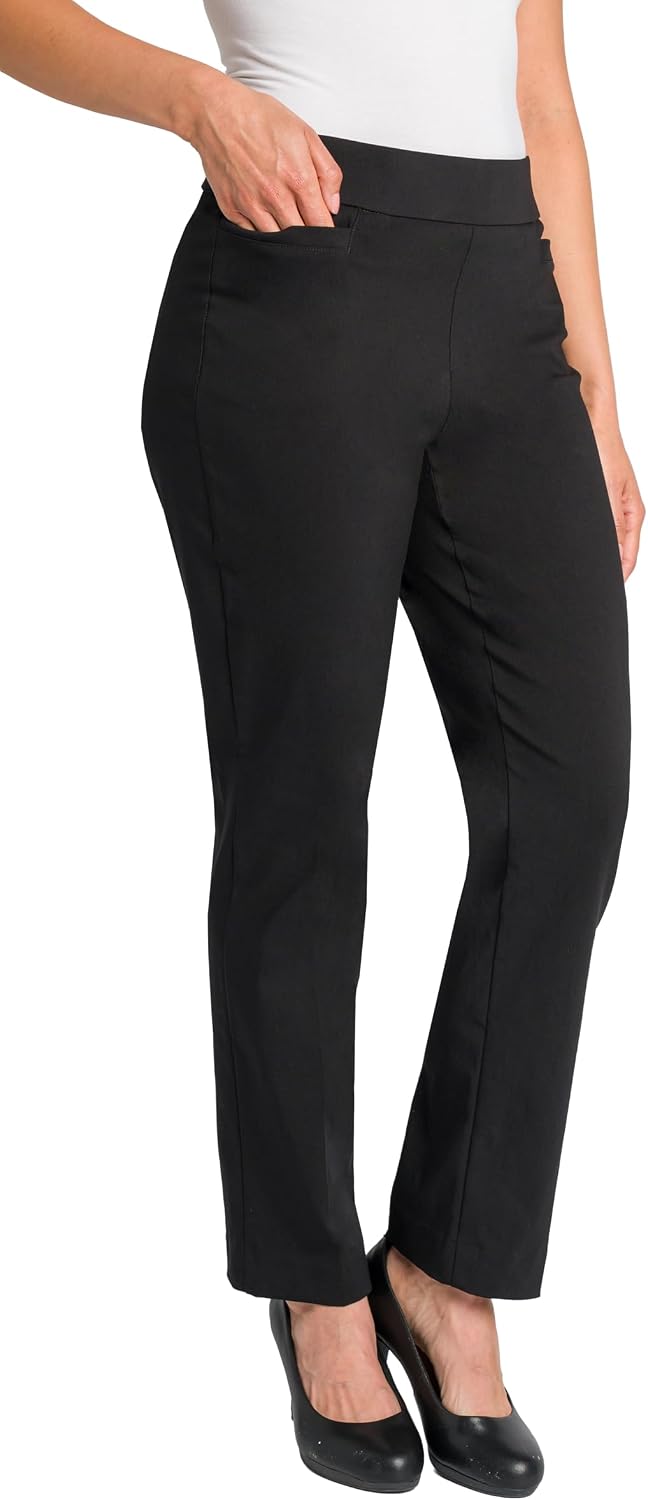
Pull-on work pants are exactly what they sound like: trousers with an elastic or stretchy waistband (no button, no zipper, no hook-and-eye closure) that you step into and pull up. They’ve become a staple for business-casual offices—the dress code category that sits between a formal suit and jeans—because they combine the polished silhouette of a traditional trouser with the forgiveness of an elastic waist. The fabric holding this category together is almost always ponte (a thick, double-knit jersey that holds its shape without being stiff), though you’ll also find versions in scuba, twill-stretch blends, and slick polyester crepes. What the category promises is universal comfort and a clean line. What it delivers depends enormously on where your body carries its weight, your height, and the specific brand’s idea of what “regular” or “size 12” actually means.
This article synthesizes patterns from hundreds of verified buyer reviews across the most-discussed pull-on work pants in the market as of mid-2026. The goal isn’t to declare a single winner—it’s to map fit outcomes by body type so you can make a faster, lower-risk decision. If you’re a 5’2” buyer with a full hip, you’ll leave here with a different shortlist than a 5’9” buyer with an athletic build and a long inseam. We’ll also tackle the questions reviewers keep asking: about pockets, shrinkage, color inconsistencies, and whether any of this looks professional enough for a client meeting.
| EDITOR'S PICKBriggs New York Women’s Pull On… | Mid-tierLee Women's Ultra Lux Comfort w… | Budget pickAmazon Essentials Women's Stret… | |
|---|---|---|---|
| Cut | Straight Leg | — | — |
| Pockets | 4 | — | — |
| Rise | — | — | Mid Rise |
| Length | — | — | Ankle Length |
| Price | $29.99 | $27.65 | $17.80 |
| See on Amazon → | See on Amazon → | See on Amazon → |
What the Data Actually Shows: Five Body-Type Profiles
Aggregating review patterns across Lee, Briggs New York, iChosy, Woman Within, and comparable brands produces some surprisingly specific signal. Buyers who leave detailed reviews tend to include height, weight, and the size they ordered—which makes this category’s review data richer than most apparel.
Profile 1: Petite and proportionate (5’1”–5’4”, straight-to-hourglass) This buyer consistently reports the best outcomes overall, because most pull-on pants are designed with a “regular” fit that—confusingly—often skews short on taller women but lands right on petite frames in the “Short” length. Reviewers at this height who order Lee’s Ultra Lux pull-on in Short frequently report that waist, hip, and length align with no hemming needed, which is a notable win in a category notorious for inseam inconsistency. The tradeoff: if you carry weight in the belly rather than the hip, the pull-on waistband can roll or bunch at the front. Reviewers flag this most often with lighter-weight ponte; thicker fabrics hold their position better.
Profile 2: Average height, fuller hip and thigh (5’5”–5’7”, size 14–18) This is the body type that generates the most review volume—and the most nuanced feedback. Briggs New York draws repeated five-star reviews from buyers in this range: one frequently cited reviewer at 5’6” and 230 lbs in a size 16 notes fit “across the board,” including through the hip and thigh, which is where most fitted trousers fail this profile. The Briggs ponte construction is thicker than many competitors, which reviewers credit for holding the shape through the seat without clinging. One caveat worth flagging below.
Profile 3: Athletic build, taller frame (5’8”–5’10”, muscular or straight through hip) This buyer has the hardest time. Pull-on pants are typically cut with the assumption that a larger waist size correlates with a fuller hip—but athletic builds often need a bigger waist with a straighter hip, and the elastic waistband doesn’t accommodate that the way a tailored cut would. Lee Ultra Lux reviewers in this profile who order Long report the length is often still too long and the front panel runs large (creating a pouch of excess fabric at the abdomen). The better match for this profile appears to be pants cut with a higher-rise front, which reduces the ballooning effect. Reviews for iChosy’s Wide Leg pull-on show more success here because the wide-leg silhouette is less fitted through the thigh—but comes with its own hazard (more on that below).
Profile 4: Short torso, fuller midsection (5’3”–5’6”, apple or round belly) The pull-on waistband is theoretically ideal for this buyer—no digging, no gaping at the back—but reviewers consistently report that a wide elastic waistband can emphasize a rounded belly rather than smooth it. The fix that works, per aggregated reviews, is a narrow or covered waistband: look for designs where the elastic is encased in fabric that lies flat rather than wide banded. Woman Within’s Ponte Bootcut is praised by this profile for exactly that reason; the waistband is modest in width and doesn’t roll. Multiple buyers report being on their second and third pair of the same pant, which is the strongest loyalty signal in the category.
Profile 5: Tall and slender or straight (5’9”+, narrow hip) The fewest reviews, but the pattern is clear: inseam is the primary variable and most brands fail it. Even “Long” lengths run short. iChosy’s Wide Leg earns a genuine five-star from a 5’10” buyer who found the length adequate—but that same reviewer flags a real workplace issue: the silky ponte fabric causes her to slide on office chairs. That’s not editorial hyperbole; multiple reviewers for that specific fabric composition note the same thing. For tall, straight-hip buyers, the silhouette question (wide leg vs. straight) matters less than the inseam and fabric grip.
The Tradeoffs You Need to Name Before You Buy
By the numbers:
- “Short” inseam across brands: 28”–29” (Lee), 27”–28” (Briggs New York), inconsistent on iChosy
- “Regular” inseam: 30”–31” across most brands—reliably lands at the ankle for 5’5”–5’7”
- “Long” inseam: 32”–34”—necessary for 5’9”+ but often overshoots 5’7” buyers who ordered Long hoping for a full-length look
- Fabric weight that holds shape without sliding: reviewers consistently prefer 230–280 GSM ponte; lighter fabrics (under 200 GSM) produce the chair-sliding effect
The color inconsistency problem is real. Briggs New York’s ponte pants in navy and black receive consistent praise for fabric weight and drape—but reviewers of the same style in lighter blue colorways note the fabric is noticeably thinner and hangs differently. This isn’t a perception issue: it appears that different dye lots or fabric batches are used for different colorways, which affects how the pant drapes and how structured the silhouette looks. The practical implication: if you’re ordering for a professional setting, stick to the darker colorways in ponte—they’re more likely to photograph as “trouser” rather than “legging-adjacent.” Per Who What Wear’s coverage of the pull-on pant category, fabric structure is the single biggest determinant of whether a pull-on reads as office-appropriate or athleisure.
Sizing and brand trust. Woman Within’s Ponte Bootcut has the highest repeat-purchase rate of any pant in this review sweep—buyers come back for their second and third pair—but the same buyers flag that sizing is inconsistent across other Woman Within products. The signal for you: this pant earns its fans, but don’t use it as a benchmark for the brand’s size chart on other items. Order the Ponte Bootcut based on its own size guide, and expect to go up one size from your usual—reviewers consistently note it runs large at the hip.
The FAQ Section That Reviewers Are Actually Asking
Frequently Asked Questions
Will a pull-on waistband look professional enough for a business-casual office or client meetings? Yes—with conditions. The key variable is fabric weight and waistband design. A thick ponte pull-on with a covered, narrow elastic waistband is visually indistinguishable from a traditional trouser in most office settings. A thin, wide, exposed elastic waistband reads as casual. Refinery29’s coverage of work-appropriate pull-ons draws the same distinction: the waistband finish, not the pull-on construction itself, is what signals formality. For client-facing meetings, pair with a structured blazer to shift the overall silhouette toward polished regardless of what the pant is doing at the waist.
How do I figure out the right inseam when brands don’t agree on what “short,” “regular,” and “long” mean? Measure your own inseam first: stand barefoot, measure from your crotch seam to where you want the hem to land (top of shoe, mid-ankle, or full ankle). Compare that number to the brand’s stated inseam for each length. Don’t assume “regular” is universal—it runs from 29” to 32” depending on the brand. Reviewers who skip this step and order by height alone report the highest return rates. Lee’s inseam labeling, for instance, runs longer than Briggs at the same length designation.
Do these pants shrink in the wash, and should I size up to account for that? Ponte fabrics with a high polyester content (most of these pants) are relatively stable—they don’t shrink the way a cotton twill would. Reviewers report more of a relaxation issue after washing: the elastic can stretch slightly over time, causing a pant that fit snugly at first to run looser after repeated washing. Woman Within buyers specifically flag this. The advice from experienced reviewers: wash cold, lay flat or low-heat tumble dry, and don’t size up preemptively—address fit after the first wash instead.
Which of these pants actually have usable pockets? This is the category’s most persistent complaint. Most pull-on work pants have either no pockets, fake pockets (a sewn-shut slit), or front pockets too shallow to hold a phone. Reviewers consistently flag Lee Ultra Lux as having functional side pockets for a key and phone. iChosy reviewers are more divided—some colorways and cuts include real pockets; others don’t. The Cut’s coverage of women’s workwear consistently notes that pocket depth is a specification worth confirming before ordering, not assuming.
Why do the navy and black versions of the same pant feel different from other colors? As noted above with Briggs New York: dye processes and the finishing treatments used for darker colorways often result in slightly heavier, more structured fabric. Some brands also source fabric in different weights for fashion colorways versus core neutrals. The practical outcome is that the same style number in black may drape like a trouser while the same style in beige or light blue moves like a knit. Reviews that note “fits differently than my black pair” are not imagining it.
Can I wear these pants if I’m between sizes or expecting weight fluctuation? This is where pull-on pants have a genuine structural advantage over traditional trousers. The elastic waist accommodates 5–10 lbs of fluctuation without needing a different size. Harper’s Bazaar’s ponte pant roundup specifically calls this out as a real-world benefit for buyers whose weight fluctuates seasonally. The limit: beyond about 10–15 lbs, the waistband starts to roll or the thigh fit becomes the binding constraint. If you’re mid-fluctuation and buying for a specific event, order for your current measurement rather than a target size.
The Decision Rule
If you’re building a professional wardrobe and this is your first pull-on trouser purchase, the framework is simple:
- Under 5’4”: Order Short and confirm the brand’s stated inseam; Lee and Briggs New York are the most consistent for this height.
- 5’5”–5’7”, fuller hip: Briggs New York in navy or black is the lowest-risk buy—fabric weight and hip fit earn the most consistent praise from this exact profile.
- 5’8”+, athletic build: Prioritize a wide-leg silhouette to reduce thigh binding; verify fabric grip before buying silky ponte for office use.
- Fuller midsection: Look for a covered or narrow waistband; Woman Within Ponte Bootcut has the repeat-purchase data to back up its fit claims, but size up.
- 5’9”+ and tall: Measure your inseam before anything else; “Long” is not a guarantee of adequate length across brands.
The category rewards methodical buyers. Reviewers who provide the most detail—height, weight, size ordered, specific fit complaints—make this unusually navigable territory. Use their specificity to your advantage before you add to cart.