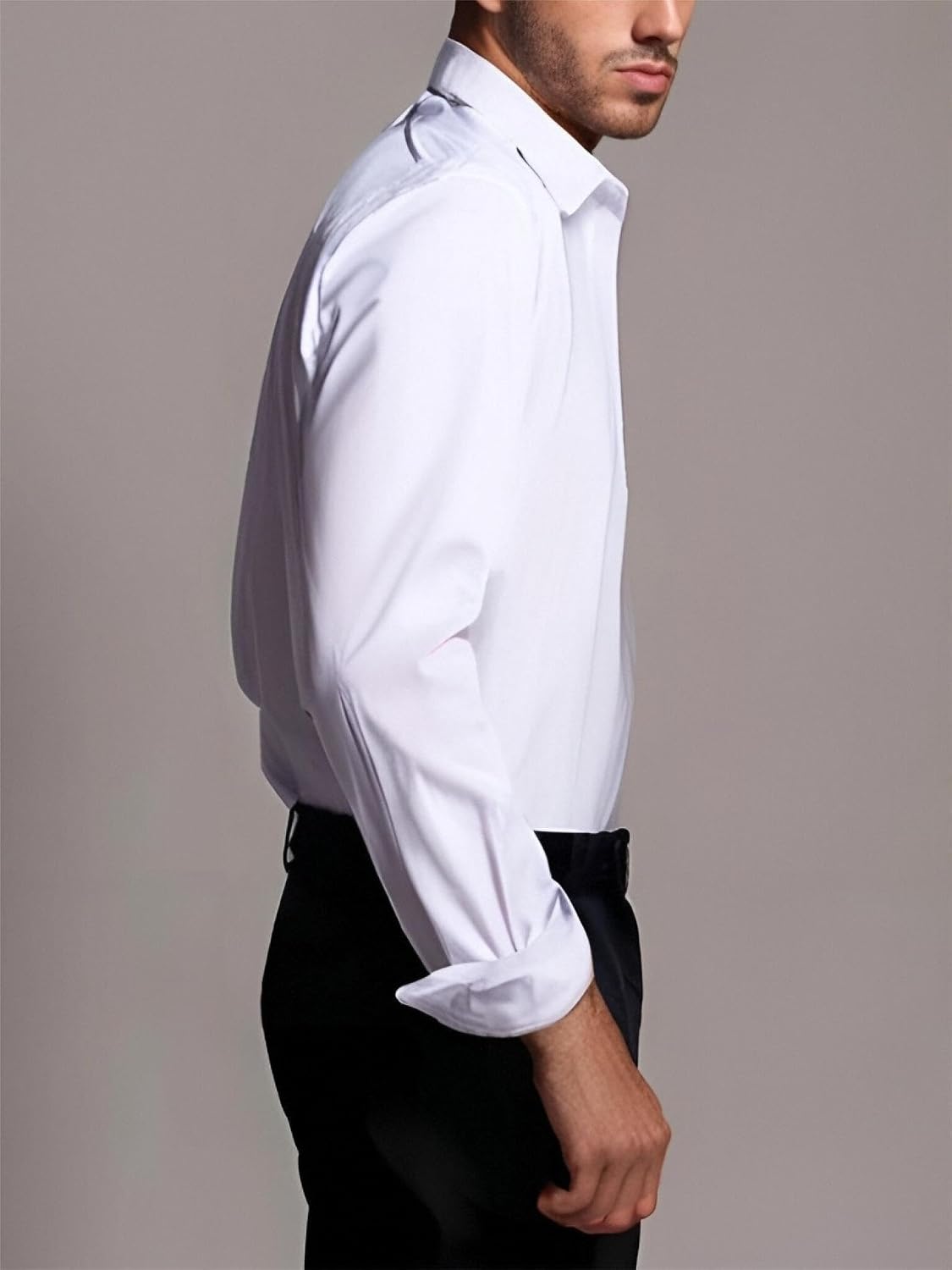
Here’s something that surprises a lot of people buying their first real work wardrobe: not all “wrinkle-free” dress shirts are using the same technology — or the same tradeoffs. The label sounds like a solved problem, but there’s a meaningful gap between a $13 multipack shirt from a warehouse brand and a $55 single shirt from a dedicated dress-shirt label. That gap isn’t just about prestige. It’s about how the fabric was treated, how long that treatment lasts, and whether you’re going to be ironing your “wrinkle-free” shirt anyway after six washes. This article maps the $13–$55 price tier in plain terms — what you’re actually buying at each level, where the real value lives, and how to make the call based on how often you actually wear dress shirts and what you need them to do.
If you’re already clear on the basics and just want the decision framework, skip ahead to the “If X, Then Y” section at the bottom. If you want to understand why the price spread exists before you spend money, start here.
| EDITOR'S PICK[Van Heusen Mens Dress Shirt Reg…](https://www.amazon.com/dp/B0979KS3KL?tag=greenflower20-20) | Mid-tier[J.VER Men's Dress Shirts Stretc…](https://www.amazon.com/dp/B09JFR5KZQ?tag=greenflower20-20) | Budget pick[BEILU Stretch Mens Slim Fit Dre…](https://www.amazon.com/dp/B0DDWQ3VVF?tag=greenflower20-20) | |
|---|---|---|---|
| Fit | Regular | — | Slim |
| Stretch | — | ✓ | ✓ |
| Stain shield | — | ✓ | — |
| Neck size | 17.5" | — | — |
| Sleeve length | 34"-35" | — | — |
| Color | White | Black | White |
| Price | $55.00 | $19.99 | $12.99 |
| See on Amazon → | See on Amazon → | See on Amazon → |
What “Wrinkle-Free” Actually Means (and Why It Varies)
“Wrinkle-free” on a dress shirt label almost always refers to a resin treatment — a chemical finish applied to the fabric that cross-links cotton fibers so they snap back toward smooth rather than crumpling when compressed. The technical name for the dominant process is DMDHEU (dimethylol dihydroxyethylene urea), though you’ll also see it marketed under brand-specific names like Supima’s easy-care finishes or Eton’s proprietary treatments. Business of Fashion’s explainer on wrinkle-free fabric notes that the finish works by reducing the cotton fiber’s ability to absorb and hold moisture — moisture being the primary driver of wrinkling.
Here’s the tradeoff: the resin that prevents wrinkling also slightly stiffens the hand (the way a fabric feels against skin) and, at lower quality levels, can degrade faster with repeated washing. It can also reduce the breathability of the fabric by partially blocking the cotton’s natural moisture-wicking ability. So “wrinkle-free” is always a negotiation between convenience and comfort — and the price tier largely dictates where on that spectrum a specific shirt lands.
By the numbers:
- Budget tier ($13–$20): typically 60/40 or 55/45 cotton-polyester blends, resin-heavy finish, 80–100 thread count range
- Mid-budget tier ($22–$35): usually 100% cotton or 96/4 cotton-elastane, moderate resin treatment, 100–120 thread count
- Upper-accessible tier ($38–$55): often Supima or pima cotton, lighter resin application supplemented by tighter weave, 120–140 thread count
Thread count in dress shirts (unlike in bedsheets, where the metric is frequently manipulated) correlates more reliably with fabric weight and smoothness at this category’s quality tiers.
The $13–$20 Tier: What You’re Actually Getting
At the bottom of the price range, you’re typically looking at multipack shirts from brands like Hanes, Van Heusen, or Amazon Essentials — shirts designed for high volume, not high durability. Wirecutter’s dress shirt review (via New York Times) notes that shirts in this range frequently use polyester-cotton blends precisely because polyester is naturally wrinkle-resistant without requiring as much chemical treatment, which helps the manufacturer hit a price point.
The practical upshot for buyers: the wrinkle resistance at this tier often works — out of the box and for the first dozen or so washes — but owners consistently report that the no-iron performance fades noticeably by wash 20–30, and that the fabric feels noticeably stiffer and warmer than cotton-dominant alternatives. Aggregated reviews across major retail platforms show a pattern of satisfied buyers in years one and two who then repurchase rather than replace, treating these shirts as a consumable rather than a wardrobe staple.
When this tier makes sense: If you wear dress shirts infrequently — say, once or twice a month for specific meetings — and you’re early in your career assembling a functional wardrobe before you know what you actually need long-term, this tier gets the job done without overcommitting. A $13–$20 shirt that you wear eight times a year and replace in three years costs less than $10/year. That math is hard to argue with when you’re still calibrating fit preferences across brands.
When it doesn’t: If you wear dress shirts two or more times a week, the lower fabric durability and declining wrinkle-resistance after heavy washing turn a cheap shirt into a recurring cost and a recurring ironing problem.
The $22–$35 Tier: The Real Decision Zone
This is where most practitioners end up spending the most mental energy, and for good reason — the value proposition here is genuinely complicated. Brands like Lands’ End Traditionals, Kirkland Signature (Costco), Banana Republic’s entry-level dress shirts, and Amazon’s own “Tailored Fit” line cluster in this range, and the quality variance within the tier is wider than in either the tier below or the tier above.
At this price point, you start seeing 100% cotton regularly, which means better breathability and a softer hand — but it also means the wrinkle-free treatment is doing more of the work, because cotton needs more chemical help to stay smooth than polyester does. GQ’s dress shirt guide notes that the 100% cotton shirts in this range often use what the industry calls a “semi-permanent” finish: it performs well for 30–50 washes before owners notice a meaningful drop in no-iron performance.
Construction details also begin to differentiate at this tier in ways that matter for how the shirt reads in a professional environment: fused vs. sewn collar stays (sewn-through stays hold their shape longer and don’t create the slight ripple a fused collar develops after washing), single-needle side seams (a cleaner, stronger seam versus the double-stitched seams common at the budget tier), and button quality (mother-of-pearl or high-density resin buttons versus cheaper plastic that cracks at the laundry stage).
Esquire’s buying guide specifically calls out the Lands’ End Tailored Fit No-Iron Supima as a consistent performer in this tier, citing reader and owner reports of durable no-iron performance beyond 40 washes — notably longer than the generic cotton shirts at the same price point. The difference, per Esquire’s sourcing, is the pima/Supima cotton base: longer-staple fibers hold the resin treatment more evenly and resist breakdown better than standard short-staple cotton.
The tradeoff to name explicitly: At $28–$35, you’re paying roughly twice the budget tier for a shirt that may last three to four times as long in usable wrinkle-resistance. If you wear dress shirts regularly, the cost-per-wear math favors this tier clearly. If you don’t, you’re paying for durability you won’t use.
The $38–$55 Tier: What the Premium Buys
Above $38, you’re generally crossing into single-brand dress shirt territory — shirts from Charles Tyrwhitt (sale price), Brooks Brothers outlet, Untuckit’s non-iron line, or Suitsupply’s entry formal shirts. The fabric quality at this level typically involves longer-staple cottons (Supima, pima, or Egyptian), lighter resin applications supported by tighter, higher thread-count weaves, and more considered construction throughout.
The key differentiation at this tier, per aggregated owner reviews and the pattern Who What Wear identifies in capsule-wardrobe coverage, is that the wrinkle-resistance mechanism is more balanced: less reliance on heavy chemical treatment, more reliance on the fabric’s natural structure. That balance tends to produce a shirt that feels softer against skin, breathes better in warm offices, and maintains its no-iron performance for significantly longer — owner reports consistently cluster around 50–75 washes before any noticeable degradation.
You also get more fit precision. Charles Tyrwhitt, for example, offers six fit options within a single collar size, which matters enormously for how a shirt reads in a professional environment. A shirt that fits correctly will always look less wrinkled than the same fabric in a poor fit, because excess fabric folds against itself and creases. This is a detail GQ’s dress shirt coverage returns to repeatedly: fit and wrinkle-resistance are not independent variables.
The honest caveat: at $38–$55, you’re still not at the tier where fabric and construction are genuinely investment-grade. These shirts are excellent everyday tools, not wardrobe pieces you’ll own for a decade. The step-change in longevity happens further up the price ladder — at Eton, Hilditch & Key, or Thomas Pink territory ($100–$200+), which is outside this article’s scope.
The “If X, Then Y” Decision Framework
Here’s the practical read for where you are right now:
If you wear dress shirts once a week or less: Start at the $22–$35 tier, prioritize 100% cotton with a Supima or pima label if you can find it, and don’t overthink it. You’ll get three to five years of usable life and genuine no-iron convenience. The budget tier is a false economy at even moderate frequency because the declining wrinkle-resistance will create friction exactly when you’re most pressed for time.
If you wear dress shirts two or more times per week: Spend $38–$55 per shirt and buy four to six of them to rotate. The cost per shirt per year over a five-year useful life at this frequency is lower than you’d expect — typically $8–$12/shirt/year — and you’ll stop thinking about whether the shirt looks right because it reliably will.
If you’re in a hybrid office and wearing dress shirts for specific high-stakes days only: The budget tier is genuinely fine, with one caveat: buy shirts that fit well from the start. A wrinkle-free shirt in a poor fit will still look slept-in. At any price tier, fit is the variable that most affects the professional read of a shirt.
If you’re building your first real wardrobe and cash is tight: Two shirts at $35 is a better foundation than four shirts at $15. The durability gap is real, and rebuilding a wardrobe of budget shirts every two years is more expensive than holding quality mid-tier shirts for four.
The $13–$55 spread in wrinkle-free dress shirts isn’t random — it maps to real differences in fabric quality, treatment durability, construction precision, and fit variety. Knowing which of those variables actually matters for your work life is the whole game. The shirt that works on your Monday morning is the one that fits your routine, not the one with the most impressive marketing language on the hang tag.