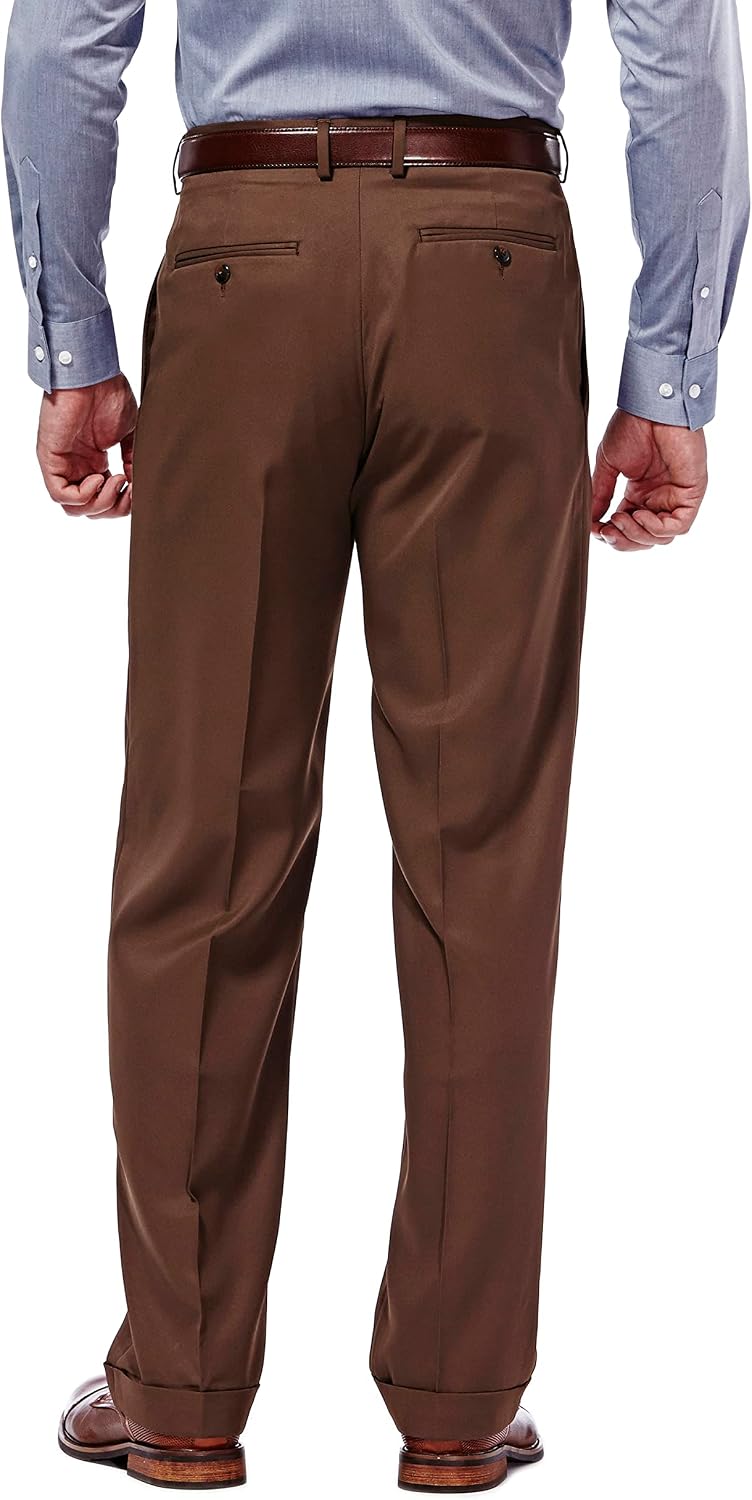
If you’ve ever loosened your belt under a conference table and hoped no one noticed, you already understand the problem these pants are trying to solve. An expandable waistband — the elastic or stretch panel hidden inside the waistband of an otherwise conventional-looking dress pant — gives you roughly an inch to two inches of extra room that activates only when you need it: deep in a long meeting, after lunch, or on a red-eye that feeds directly into a client breakfast. The outside looks like a standard tailored trouser. The inside stretches. The concept has been around for decades, most famously at Haggar, an American workwear brand that has been making dress pants since 1926 and built much of its modern identity around comfort-forward office trousers at accessible price points. This article uses aggregated owner reviews and published product specs to answer the question every practical professional is quietly asking: is the expandable waistband a genuine quality-of-life upgrade, or is it the trouser equivalent of a hotel pillow menu — a feature that sounds good on paper and disappoints in practice?
The short answer, based on what owners consistently report across Haggar’s current range, is: it depends entirely on who you are and how you wear them. Let’s map the decision.
What the Expandable Waistband Actually Does — and Doesn’t Do
The mechanism is simpler than the marketing makes it sound. Inside the waistband, typically hidden behind the button closure, sits a strip of elastic or a stretch panel — usually one to two inches of give on each side. When you’re standing, the pant looks and behaves like any other dress trouser. When you sit, bend, or simply expand post-lunch, that elastic absorbs the pressure rather than transferring it to your gut or your belt loops.
Haggar’s Cool 18 Pro and Premium Comfort lines both use this construction, and owner reviews across both product lines consistently note that the stretch is subtle in the best possible way. You don’t feel it activate dramatically — it simply stops the waistband from cutting in. Reviewers who describe themselves as having “big thighs” relative to their waist size repeatedly flag this feature as the reason they keep repurchasing: traditional flat-front dress pants sized for the waist leave no room through the seat and thigh, forcing a trade-off between comfort and silhouette. The hidden expansion gives back some of that margin without requiring you to size up and then deal with excess fabric everywhere else.
By the numbers:
- Haggar’s published specs describe the expandable panels as providing approximately 1.5 inches of additional waist allowance
- Owner reviews cite the feature as most noticeable during prolonged sitting (3+ hours) rather than standing movement
- The Cool 18 Pro flat front is the most-reviewed style in this category, with consistent mention of all-day wearability across multi-year purchase histories
One caveat worth naming: the expansion is passive, not adjustable. You cannot dial it in or lock it out. If you’re between sizes or carry weight inconsistently, the waistband will float slightly when you’re not expanded — a minor annoyance some reviewers mention, though most describe it as invisible under a belt or tucked shirt.
The Fit Problem These Pants Were Built to Solve
Dress pants have historically been cut for a narrow, proportionally balanced body — roughly the same measurement through the seat and thigh relative to the waist. That silhouette describes fewer working professionals than the industry used to assume, and it’s a big part of why the GQ and Esquire best-dress-pants guides both note that fit is consistently the number one complaint in the category (GQ’s recurring “Best Dress Pants for Men” guide names proportion as the central challenge; Esquire’s roundup calls out the “thigh gap problem” explicitly).
Men with larger thighs relative to their waist — whether from athletics, build, or simply where they carry weight — face a binary: size up for the thigh and take in the waist (which requires tailoring and adds cost), or buy the waist size and accept a pant that’s uncomfortable to wear for more than a couple of hours. Haggar’s pleat-front styles address the thigh issue structurally, because pleats (the folds of fabric at the waistband front that release downward toward the knee) add circumference through the upper leg without adding fabric at the waist. The expandable waistband then handles the secondary pressure point.
A Premium Comfort reviewer who described losing weight and “finally finding his correct size” after several attempts is a useful data point here: fit accuracy at the waist is especially important with these pants because the elastic is a buffer, not a substitute for correct sizing. The Wirecutter’s men’s dress pants guide makes this same argument more broadly — stretch features work best when the base fit is already close; they’re not a license to approximate.
If you carry weight through the thigh and have a proportionally smaller waist, the practical recommendation based on aggregated owner experience is: size for the thigh on pleat-front styles, use the hidden expansion to absorb any waistband tightness, and consider a tailor visit if the seat still bags. That combination is far cheaper than bespoke and produces a significantly better result than either sizing strategy alone.
Do Pleat-Front Styles Look Dated? A Real Office-Ready Assessment
This is the question style-conscious buyers ask most often, and it deserves a direct answer: in 2026, pleats are no longer a liability in business-casual environments — but only if the rest of the trouser’s proportions are contemporary.
The concern was legitimate in the early 2010s, when menswear went through a prolonged slim-silhouette phase and pleats became associated with early-2000s dad dressing. That cycle has turned. GQ and Esquire both noted in their 2024 and 2025 roundups that pleated trousers have returned to the mainstream across office and smart-casual contexts, driven partly by the influence of Italian and Scandinavian workwear aesthetics that prioritize comfort and movement alongside tailoring.
The practical distinction for Haggar’s pleat-front styles is this: a single forward pleat in a medium-rise, straight-leg silhouette reads as appropriately contemporary in most business-casual environments. A double reverse pleat in a high-rise, full-leg cut reads as more formal and traditional — appropriate for certain industries (finance, law, client-facing roles with conservative dress expectations) but potentially conspicuous in creative offices, tech, or agency environments where the team norm has settled around slim flat-fronts or chinos.
If your office leans creative or your team is under 35, the flat-front Cool 18 Pro is the lower-risk entry point. If you’re in a traditional industry or simply prefer the comfort geometry of pleats, the gabardine pleat-front styles read as intentional rather than dated in 2026, particularly when worn with a clean Oxford or a slim crew-neck sweater rather than a boxy dress shirt.
Fabric Quality: Has Haggar’s Legacy Changed?
Long-term Haggar wearers — reviewers with purchase histories spanning five-plus years — raise a consistent observation: the fabric in newer product generations feels lighter than what they remember from older versions of the same styles. This is worth naming honestly rather than dismissing.
A lighter fabric in dress trousers can mean two different things. In premium tailoring, a lighter weight is usually a feature — high-twist wools and fine blends drape better, wrinkle less, and travel more comfortably. In a value-tier workwear context, lighter fabric can signal a cost-reduction decision that trades durability and structure for a lower price point. Haggar’s current price tier puts these firmly in the latter category, and the reviewer pattern suggests the latter interpretation is more accurate: several owners note the fabric “doesn’t hold its shape as well” over multiple wears compared to older versions of the same pant.
This isn’t disqualifying, but it’s a calibration point. At Haggar’s price point, you are buying comfort engineering and reasonable longevity — not investment-grade cloth. Owners who treat these as work-horses, rotating two or three pairs through the week, report multi-year service lives. Owners expecting the fabric behavior of a mid-tier Suitsupply or a Club Monaco trouser will be disappointed.
For buyers coming down from that tier — perhaps looking for a comfort-focused pant for travel days or casual Fridays — the trade-off is explicit: you’re gaining the expandable waistband comfort feature and losing some of the fabric density and structure you’re accustomed to. Whether that trade makes sense depends on how you’re deploying the pant.
Colorway, Care, and Versatility: The Practical Details
Which colors to buy: Navy, charcoal, and medium grey are the three colorways that deliver the broadest utility in business-casual environments, and owner reviews consistently identify these as the most-reached-for options. Khaki and tan extend into smart-casual territory — they pair well with navy blazers, unstructured sport coats, and merino crew necks for the office-to-dinner transition several reviewers specifically describe.
The white and light colorways deserve a specific note: the Cool 18 Pro reviewer who observed that the white option runs “slightly yellow next to true white” is flagging a real issue for anyone buying for an event, a wedding, or a meeting where they’ll be alongside people in true white. For everyday office wear, this won’t matter. For occasions where color-matching matters, buy the standard neutrals instead.
Care: Haggar’s expandable waistband styles are machine washable — a genuine practical advantage over dry-clean-only dress trousers, and one that owners mention repeatedly as a reason for repurchase. Cold water, gentle cycle, hang dry is the standard instruction across the range. A few reviewers note that tumble drying accelerates pilling on lighter-weight versions; hang drying preserves the fabric longer.
Frequently Asked Questions
How much does the expandable waistband actually give — is it noticeable in use? Haggar’s published specs describe approximately 1.5 inches of additional waist allowance. Owner reviews describe it as passive and invisible — you don’t feel it deploy; you simply stop feeling the waistband constrict. Most reviewers say they notice it most during extended sitting.
Do the pleat-front styles look dated in a modern business-casual office? Not in 2026. Single forward pleats read as contemporary in most environments; double reverse pleats skew more traditional. Match the style to your office’s actual dress norm, not the dress code on paper.
Has Haggar’s fabric quality changed compared to older versions? Long-term owners say yes — newer generations run lighter. It’s still serviceable workwear fabric, but it no longer has the density that older Haggar loyalists remember. Set expectations accordingly.
Do these work for men with large thighs but a proportionally smaller waist? Yes — this is arguably the core use case the pants were designed for. Pleat-front styles add thigh room structurally; the expandable waistband handles the secondary pressure. Size for the thigh, not the waist.
Which colorways are most versatile for a business-casual wardrobe? Navy, charcoal, and medium grey first. Khaki as a smart-casual extension. Avoid white or cream if color accuracy matters for your specific use.
Can these be machine washed or do they need dry cleaning? Machine washable. Cold water, gentle cycle, hang dry. This is a meaningful practical advantage at the price point and one of the most-cited reasons owners repurchase.
The Decision Rule
If you sit for most of your workday, carry weight through the thigh, or have ever quietly loosened your belt in a meeting — these pants solve a real problem at a price that makes rotation easy. The expandable waistband is not a gimmick; it’s a comfort feature with genuine all-day utility, and owner reviews across Haggar’s range consistently confirm it.
If you’re coming from a higher fabric tier and care primarily about how a trouser drapes and holds its press over a long week, these will feel like a step down — the lighter-weight fabric is a real trade-off, not a negligible one.
The if-then version: If your priority is all-day seated comfort and easy care at an accessible price, buy the flat-front Cool 18 Pro in navy or charcoal first. If you have proportionality challenges through the thigh, add a pleat-front style in charcoal or khaki and size for the thigh. If you’re buying for an event where color precision matters, skip the light colorways entirely.