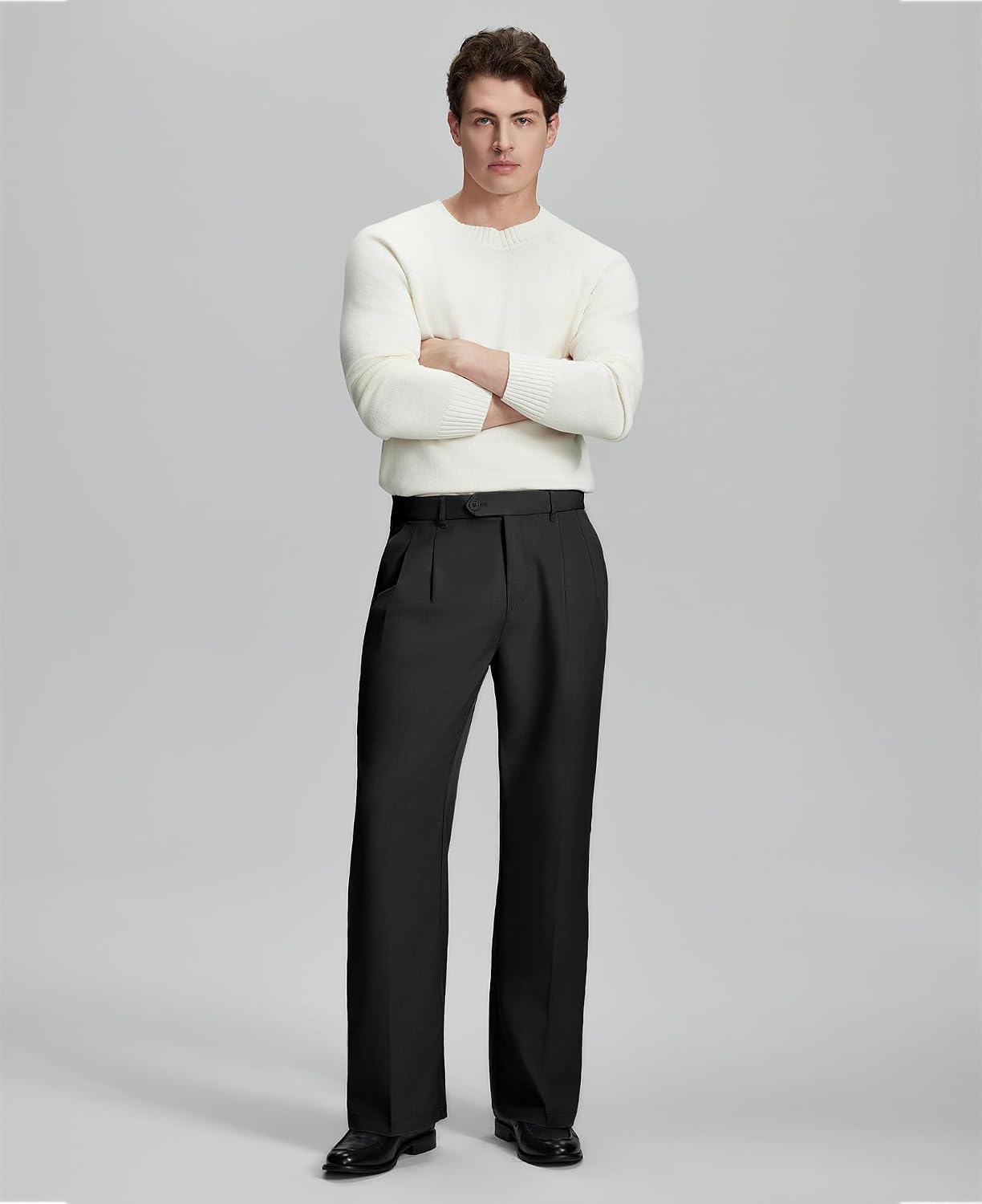
Pleated trousers — dress pants with folds of fabric stitched into the waistband, creating extra volume through the hip and thigh before tapering toward the ankle — fell out of fashion during the slim-fit revolution of the 2010s. For almost a decade, any trouser with a pleat read as your dad’s suit pants. Now they’re one of the most-discussed silhouettes in professional dressing, championed by a loose cultural shorthand called “old money” style: understated, well-made, quietly expensive-looking. The appeal is real. Done right, a pleated trouser is more comfortable than a slim pant, drapes more elegantly, and signals a certain ease with formal dressing rather than effort. Done wrong, it looks like you borrowed clothes from a 1987 accounting firm. This guide gives you the decision framework to stay on the right side of that line.
If you already own a pair and are trying to figure out why they’re not quite working, start at the fit section. If you’re shopping, start at the tier comparison. Either way, the goal is the same: make the silhouette look deliberate, not dated.
Why Pleated Trousers Feel Fresh Again — and Why That Creates a Risk
The revival is real and documented. GQ’s coverage in 2024 pointed to the pleated trouser as a centerpiece of what they called “the new tailoring looseness” — a broader move away from body-skimming silhouettes toward cuts that suggest confidence rather than restriction. Business of Fashion’s 2025 analysis of runway-to-retail translation noted that wider-leg and pleated shapes had moved from editorial novelty to consistent commercial sell-through at mid-tier and premium retailers, with Zara, Massimo Dutti, and Theory all expanding their pleated offering.
But the same cultural moment that makes pleated trousers feel relevant also creates the “costumed” trap. The old-money aesthetic, as Who What Wear documented in their 2025 breakdown, is appealing precisely because it looks unconstructed — like someone who inherited good taste rather than performed it. The risk for professionals is overcorrection: leaning too hard into period-accurate styling (double forward pleats, suspenders, Oxford bags, vintage-cut blazers all at once) produces a look that reads as costume rather than wardrobe.
The underlying principle: The pleat itself is not the problem. Volume concentrated in the wrong place — or paired with too many other retrograde signals — is the problem.
The Fit Variables That Separate “Polished” from “Shapeless”
Pleated trousers require more precise fit attention than slim pants, not less. Here are the four variables that matter most:
Waist rise. Pleated trousers are designed to sit at or above the natural waist — roughly at the navel, not the hip. Wearing them at hip height (the default for most modern trousers) collapses the pleat into a bunched mess and adds bulk exactly where you don’t want it. If you’re buying off the rack, this is the first thing to confirm. Reviewers across style forums consistently note that the most common mistake with pleated trousers is wearing them too low.
Pleat direction. Forward pleats (folding toward the fly) are the modern standard and work in virtually every office context. Reverse pleats (folding away from the fly, toward the pockets) are rarer, read as more vintage, and require a cleaner, higher-rise fit to avoid looking sloppy. For a first pleated trouser, forward is the lower-risk choice. Esquire’s guide to wide-leg office trousers specifically flags reverse pleats as better suited to experienced wearers who know their proportions.
Taper below the knee. The upper-block volume created by a pleat needs to resolve somewhere. Trousers that stay wide all the way to the hem tend toward the theatrical; a subtle taper from the knee down creates the elegant drape that makes pleated trousers look considered. The hem should land at or just above the shoe, with a small break or no break — not pooling.
Hip-to-thigh ease. This is where pleated trousers earn their comfort advantage. You want meaningful room through the seat and thigh — not billowing, but noticeably more than a tailored slim fit. If you sit down and the pleat pulls open completely flat, the trouser is too tight and the fit is fighting the garment’s design logic.
By the Numbers
| Variable | Watch out for | Target range |
|---|---|---|
| Rise | Hip-hung (below navel) | Natural waist (at or near navel) |
| Hem break | Full break / pooling | No break to quarter break |
| Thigh room | Pulling taut at pleat | Relaxed drape, pleat lying flat |
| Taper | Straight leg to floor | Subtle taper from knee |
What $150, $400, and $900 Actually Buy You
The pleated trouser market spans a wide price range, and the performance gap is genuine. Here’s what each tier delivers based on published construction specs and aggregated reviewer reporting.
Entry tier ($80–$200): Zara, ASOS, H&M, Abercrombie & Fitch — These are mostly polyester-viscose blends or poly-wool mixes (typically under 30% wool). Pleat construction is adequate; the issue reviewers consistently flag is that synthetic-heavy blends don’t drape — they hold a pressed shape briefly, then develop a shine and lose structure. For a younger professional building a first rotation, these serve as proof-of-concept pieces. Owners report they photograph well but don’t hold up to weekly wear beyond a season or two.
Mid tier ($200–$500): Banana Republic, Club Monaco, COS, Suitsupply, Massimo Dutti — This is where the value equation improves most sharply. Suitsupply in particular earns consistent praise from style reviewers for its wool-blend pleated trousers, which use proper canvas or half-canvas waistband interlinings (internal structure that helps the trouser hold its shape). COS takes a slightly different approach — their pleated silhouettes are fuller and more relaxed, leaning into the architectural dimension of the pleat rather than a traditional tailored line. Worth noting: “relaxed” at COS means genuinely wide; their sizing notes and reviewer commentary suggest sizing down if you’re buying for a polished office environment rather than a creative studio.
Investment tier ($500–$1,200+): Theory, Reiss, Vince, Sandro, Joseph, Brunello Cucinelli diffusion — At this level you’re paying for fabric quality (genuine S100–S130 wool counts, cashmere blends, ponte that actually holds its structure), fully functional waistband construction, and hand-finishing that affects how the pleat lies after dry cleaning. Vogue’s 2025 coverage of the pleated revival highlighted Theory’s high-rise pleated wool trouser as a benchmark piece in this tier — reviewers note the pleat lies flat without pinning or pressing between wears in a way that entry-tier synthetics simply don’t replicate. Resale value at this tier is also meaningful: Theory and Joseph pleated wool trousers in neutral tones (oatmeal, camel, charcoal) hold 35–50% of retail on Vestiaire Collective and The RealReal based on active 2025–2026 listings, versus near-zero resale for fast-fashion pleated styles.
Pairing Logic: Avoiding the Costume Trap
The “costumed” failure mode comes from stacking period signals. The pleated trouser is already doing significant visual work. Your job everywhere else is to counterbalance it with modernity.
Top pairings that work:
-
Clean, slim-fitting knitwear (a fine-gauge merino crewneck or lightweight turtleneck) neutralizes the trouser’s volume with a calm top half. The contrast between a slim torso and a fuller leg is the same proportion logic that makes a good wide-leg look work.
-
An unstructured blazer or overshirt worn open, in a tonal or complementary shade, reads as intentional rather than matched. A camel blazer over off-white trousers, or a slate grey merino over charcoal pleated wool, lands as considered layering.
-
Minimalist leather footwear — a clean loafer, a simple Oxford, a pointed-toe flat for a more feminine interpretation — grounds the silhouette. Chunky-soled shoes introduce a second strong statement that competes with the trouser volume.
Combinations to approach carefully:
-
Double-breasted jacket + pleated trouser + tie is three traditional tailoring signals at once. In a conservative finance or law environment, this can work if everything fits impeccably. In a creative or hybrid-casual office, it reads as period costume rather than authority.
-
Suspenders (braces) are the easiest way to cross into theatrical territory. Unless your workplace dress code is genuinely formal, hold these for weekends or deliberate occasions.
-
Patterned shirts with strong prints fight the drape of the trouser. Solids and subtle textures let the silhouette lead.
The gender-inclusive note: Vogue’s 2025 coverage documented the pleated trouser revival equally across women’s and men’s tailoring — several women’s-cut pleated trousers now offer the most dramatic proportions in the market (Toteme, Sandro, and Joseph all received editorial attention for their high-rise wide-leg pleated styles). The pairing logic above applies regardless of how a garment is gendered; the core principle — let the trouser be the statement, quiet everything else — holds across all versions.
The Decision Framework
Here’s the clearest way to think through whether a pleated trouser belongs in your rotation right now:
If your office environment is hybrid-casual or creative (agency, architecture, brand, UX, consulting): Pleated trousers are well-suited and will read as intentional. Start with a mid-tier option at Suitsupply or COS, confirm the rise and taper fit before committing, and pair with a fine-gauge knit. This is a low-risk, high-reward move.
If your environment is business-professional or client-facing formal: Pleated trousers work — they’re historically correct for formal tailoring — but fit precision matters more. Invest in the $400–$600 tier where proper construction keeps the pleat lying flat, and have them hemmed by a tailor. Avoid stacking with other traditional tailoring signals unless you know your environment well.
If you’re still in a slim-trouser mindset and haven’t tried the fit yet: Don’t buy based on what you see on a mannequin or runway photo. The rise adjustment alone can feel counterintuitive. Try on in-store at Massimo Dutti or Suitsupply before committing to an online order. The fit is learnable, but it takes one in-person calibration to understand your proportions in this silhouette.
If you’re considering an investment-tier purchase: The resale math supports it for neutral wool trousers at Theory, Joseph, or Vince. A $520 Theory pleated trouser that you wear for three years and resell for $180 costs $113/year — less than two mid-tier pairs that won’t hold their drape or resale value. The cost-per-wear argument for quality pleated wool is stronger than it looks at the sticker price.
The pleat is not a risk. It’s a decision. Make it deliberately, fit it correctly, and it’s one of the more quietly authoritative silhouettes available to professionals right now.